What are MacKenzie Scott's books about? $50,000 in prizes for the essays that answer best. No entry fee.
She has published three novels. Thirteen essays on them will win, and all thirteen will be published together in an anthology, the first book of criticism devoted to her fiction.
First prize is $25,000 for a single essay.
Read one novel or all three. Argue whatever you can support.
Judged blind. Your name never reaches the judges.
Why this prize
MacKenzie Scott is an extraordinary figure. She was there at the founding of Amazon. She has become one of the most significant philanthropists of our time, and she has pioneered new ways of giving money away. And she is a serious novelist: she studied writing with Toni Morrison, and her first novel won an American Book Award.
Yet her fiction has hardly been studied. The novels were reviewed when they came out, but almost no one has written about them at length. She says very little in public, and her books are the one place where she speaks at length in her own voice.
This prize exists so that those books are read closely. Admire them or argue with them. What matters is that your case is grounded in the text.
I have no connection to Ms. Scott, and she is not involved in any way.
Michael de la Maza
Two minutes from the founder of the prize. Watch on YouTube if the player does not load.
Prizes
| First | $25,000 |
| Second | $10,000 |
| Third | $5,000 |
| Ten finalists, each | $1,000 |
Prizes are paid when the winners are announced. Payment does not wait for the book.
Every prize comes with publication in the anthology.
The novels
MacKenzie Scott has published three novels over two decades. They have been reviewed, but almost nothing sustained has been written about them. This prize exists to change that.
- The Testing of Luther Albright2005
- Traps2013
- Last Days in Two NationsSerialized on Substack
Your essay can treat one novel, compare two, or read all three together.
What to send
One essay of up to 8,000 words, in English, that answers the question: what are MacKenzie Scott's books about? We have no preferred school, method, or verdict. Close reading, theory, comparison with other writers, a skeptical case against the books: all are welcome if the argument is grounded in the text.
The essay must be your own unpublished work. Anyone may enter, from anywhere, with or without an academic affiliation. One entry per person.
Using AI
You may use AI tools. You must say exactly how. Every entry includes an AI disclosure, and each winning essay's disclosure will be printed with it in the anthology.
Essays that sound as if an AI wrote them will probably not win, for a simple reason: we are expecting a much higher quality of writing than that.
Your disclosure answers four questions, in a sentence or two each. If the answer is none, say none.
- Tools. Which AI tools did you use, if any?
- Research. Did AI help you find sources, summarize the novels or other texts, or check facts?
- Writing. Did AI draft, rewrite, or suggest any sentences, arguments, or structure?
- Proofreading. Did AI check spelling, grammar, or citations?
Three examples of what a disclosure can look like:
No AI. Tools: none. Research: none. Writing: none. Proofreading: none. I used my word processor's ordinary spell check.
Proofreading and research. Tools: Claude. Research: I asked it to suggest critics who have written about domestic realism, then read those critics myself. Every quotation in the essay comes from my own reading. Writing: none. Proofreading: it checked the final draft for typos and citation format.
Writing help. Tools: ChatGPT. Research: none. Writing: I wrote the full draft, then asked for a critique of the argument in my third section and rewrote that section myself in response. It also suggested the essay's title, which I kept. Proofreading: grammar check on the final draft.
You are responsible for every word and every quotation, whatever tool produced it. An entry whose disclosure turns out to be false or incomplete will be disqualified.
Dates
- Submissions open
- Submissions close
- Winners announced
- Anthology published
Leave your name off the essay file. You will enter it separately when you submit.
Judging
Every essay is read blind, twice, by trained first-round readers. The strongest go to a panel of judges drawn from university literature faculties and working critics, who choose the thirteen winners.
The judges may decline to award any prize for which, in their judgment, no essay meets the standard of the competition. The anthology will be published only if the judges select at least eight essays for it. If it is not published, all rights in every essay stay with its author. Whatever the outcome, it will be announced on this site by August 31, 2027.
The panel will be announced here before submissions open.
A judge who recognizes an essay sits out that decision.
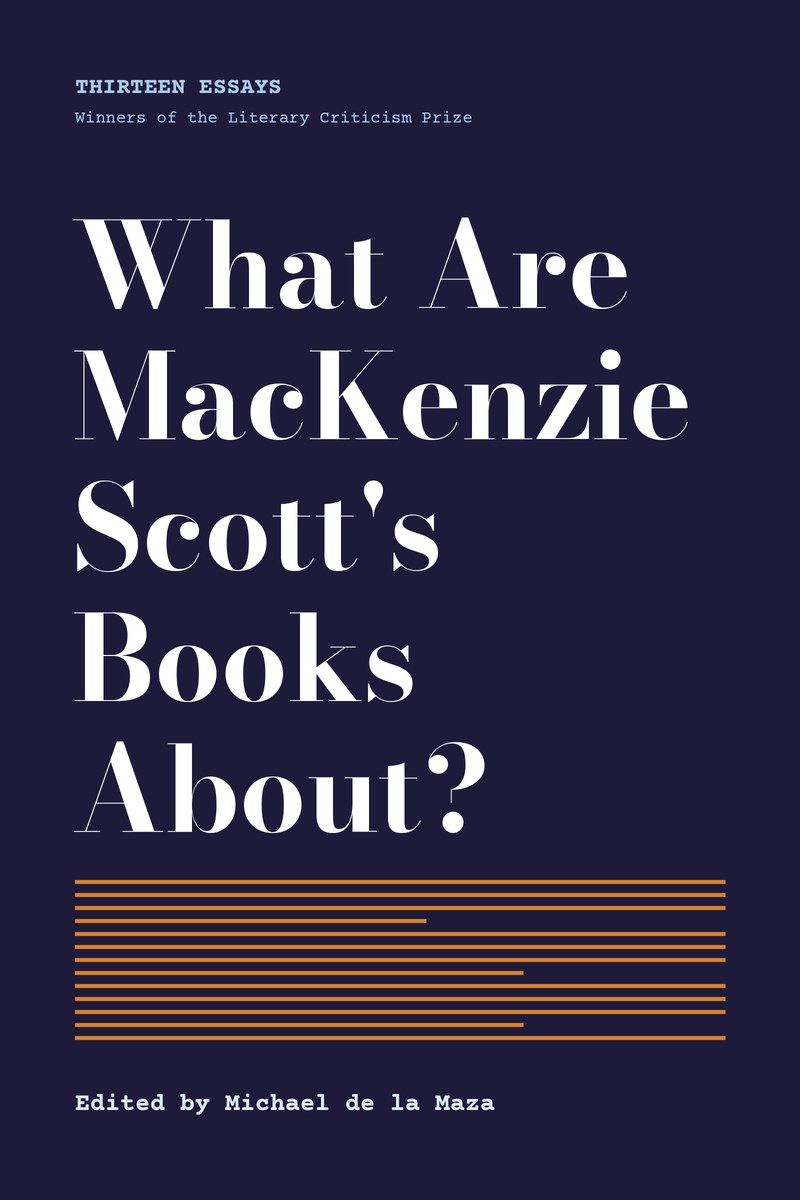
The book
The thirteen winning essays will be published together as What Are MacKenzie Scott's Books About? Thirteen Essays, edited by Michael de la Maza.
Each essay appears under its author's name, with the author's AI disclosure printed beside it. Authors keep the copyright.
Working cover. Final design to come.
Questions
Is this prize connected to MacKenzie Scott?
No. The prize is independent. Ms. Scott has no involvement in it and has not endorsed it.
Who is behind it?
The prize is funded and organized by Michael de la Maza of Cambridge, Massachusetts, who will edit the anthology.
Who owns my essay?
You do. Authors keep the copyright.
If your essay wins, you give the prize the right to publish it first, in the anthology, in print, ebook, and audiobook editions. The prize may keep the book on sale, issue new editions, and quote excerpts on this site and in publicity. Winning essays must not be published anywhere else until the anthology is out. After that, you are free to publish yours wherever you like.
The prize money is the full payment. There are no royalties.
Essays that do not win remain entirely yours, and no rights are taken.
Could a prize go unawarded?
Yes. The judges, not the organizer, may withhold any prize if no essay meets the standard, and the anthology will be published only if at least eight essays are selected. We expect to award all thirteen prizes. If the book is not published, you keep all rights to your essay.
When are prizes paid?
When the winners are announced. Payment does not depend on the anthology being published.
Why is there no entry fee?
Because the point is to get the best essays, and a fee keeps good writers out.
How do I submit?
A submission link will appear on this page on February 1, 2027.
Another question? Write to michael.delamaza@gmail.com.